No matter what kind of restaurant you run or how long you’ve been in the business, all quick-service owners and operators want the same thing: long-term restaurant profitability.
But how can you narrow down what “profitability” actually means?
Can quick-service restaurants increase sales without eroding profit margins?
And what are the best practices for quick-service restaurants to reach profitability (and stay there)?
Our ultimate guide to quick-service restaurant profitability answers all of these questions — and more.
Let’s dive in.
What Quick-Service Restaurant Profitability Really Means
“Quick-service restaurant profitability” goes beyond a single definition or profit margin.
Profitability is composed of multiple factors that contribute to your business growth and your bottom line, from revenue and cost of goods sold to gross and net profit margins. — and there are just as many factors that impact how profitable your restaurant is at any given time.
Here are the top six factors that contribute to your QSR’s profitability.
1. Revenue — Your restaurant’s revenue is how much money you bring in from all sales before subtracting any expenses or costs.
2. Cost of Goods Sold (COGS) — Your COGS is the direct costs associated with producing what your restaurant sells (i.e., food and beverages), including both materials and labor.
Formula: COGS = Beginning Inventory + Purchases – Ending Inventory
3. Gross profit margin — Your gross profit margin is the revenue your restaurant brings in after subtracting only your COGS.
Formula: Gross Profit Margin = (Revenue – COGS) / Revenue x 100
4. Net profit margin —Your net profit margin is the total revenue your restaurant brings in after you cover all costs, including COGS, operating expenses, and taxes.
Formula: Net Profit Margin = (Net Income / Total Revenue) x 100
5. Operating profit margin — Your operating profit margin is the revenue your restaurant brings in after subtracting all indirect operating costs, including payroll, rent, and utilities.
Formula: Operating Profit Margin = (Operating Income / Revenue) x 100
6. Cash flow — Your cash flow is the movement of money within your business. It includes the money that goes into your business, like sales, and the money that goes “out” of your business, like expenses.
Formula: Net Cash Flow = Total Cash Inflow – Total Cash Outflow
The Core Metrics Every QSR Operator Should Track
Alongside COGS and the different profit margin calculations, quick-service restaurants should regularly track several other cost-related metrics, too.
Food cost percentage, average order value, sales per labor hour… these metrics can provide key insights into profitability at the item- and service-levels, so you can ensure you’re maximizing profit anywhere and everywhere you can.
Here are the eight core cost metrics that every successful restaurant operator should track.
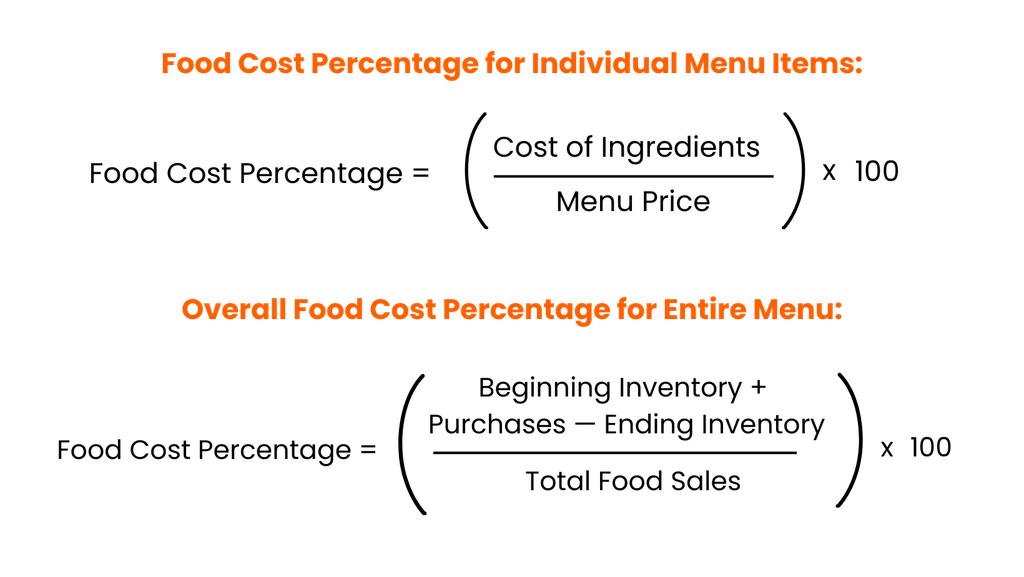
1. Food cost percentage — Food cost percentage is the ratio between the money your coffee shop spends on its menu items (“food cost”) and the money you earn on food (“food sales”).
Formula:
2. Labor cost percentage — Your labor cost percentage is the ratio of your restaurant’s total labor expenses to your gross sales for a given time period, expressed as a percentage.
Formula: Labor Cost Percentage = Labor Cost / Gross Sales x 100
2. Prime cost — Your restaurant’s prime cost is the total of your food and beverage costs (COGS) and your labor costs for a specific time period, typically expressed as a percentage.
Formula: Prime Cost = (COGS + Labor Cost) + Total Sales x 100
4. Average order value (AOV) — Your AOV is a representation of how much customers spend at your coffee shop on average during a specific time frame.
Formula: AOV = Total Revenue / # of Orders (for a specific time frame)
5. Contribution margin — Your contribution margin is the revenue from a specific menu item after subtracting how much it costs to actually make that item.
Formula: Contribution Margin = Selling Price – Food Cost
6. Sales per labor hour — Your sales per labor hour represents how many sales (and how much revenue) you bring in for every hour of labor you’re paying for.
Formula: Sales Per Labor Hour = Total Sales / Total Labor Hours
7. Ticket counts — Your ticket count is the total number of tickets (or customer orders) you process in a specific time period, whether that’s throughout one shift or an entire day.
8. Repeat purchase rate — Your repeat purchase rate is the number of customers served more than once, expressed as a percentage of your total unique customers.
Formula: Repeat Purchase Rate = (# of Repeat Customers / Total # of Unique Customers) x 100
Regularly exploring these top quick service restaurant trends and benchmarking them over time can give you invaluable insight into how your business is performing in any given period.
This gives you a more holistic (and accurate) view of profitability and performance, and long-term data and analysis > any single number in isolation.
How to Increase Sales Without Eroding Margins
Maintaining quick-service restaurant profit margins while also increasing sales can feel like a constant struggle for owners and operators. How can you invest in growth strategies while still keeping your bottom line intact?
Luckily, there are several ways to boost your quick-service restaurant’s sales without eroding your profit margins — and some of them are free.
Optimize menu mix and pricing
The first (and totally free!) way to increase sales is by optimizing your QSR menu for profit.
The best way to do this is through menu engineering, a process where you isolate each of your menu items, assess its profitability and popularity, and use that data to optimize your menu.
At its core, the menu engineering process works like this:
- Choose a time frame to focus your menu analysis, whether that’s a week or a month.
- Figure out your menu items’ profitability and popularity with three calculations: food cost per menu item, menu item contribution margin, and menu item popularity.
- Categorize your menu using the Menu Matrix, assigning Plowhorse, Star, Dog, and Puzzle labels to different items based on their profitability and popularity.
- Use menu engineering strategies like ingredient substitutions and intentional marketing to maximize the profits of every menu item, from Plowhorses to Puzzles.
- Evaluate performance and continuously optimize your changes using menu engineering strategies.
Outside of menu engineering, you can also optimize your sales by implementing and testing different menu pricing strategies for QSR profitability. Try out a temporary price adjustment that earns you more sales, or experiment with portion sizes and bundles that save you and your customers money.
Test the changes against sales volume and guest response, adjust, and try again until you’ve reached an optimal level for your bottom line.
→This is a very simplified view of the menu engineering process, but you can check out our menu engineering blog for a more detailed breakdown of all five steps!
Increase repeat visits with loyalty and retention
Another great way to increase sales without eroding your margins is to launch a loyalty program that encourages customer retention and builds long-term restaurant profitability.
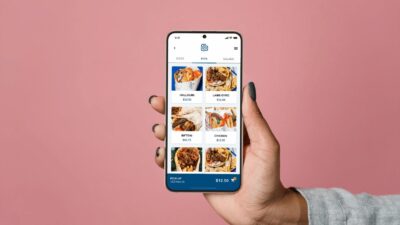
One way to do this is by launching a mobile app with loyalty program capabilities (like Craver’s custom-branded apps). This allows your restaurant to leverage the effectiveness of restaurant loyalty programs and the lifetime-value-increasing benefits that encourage retention, including:
- Personalized rewards that make customers feel seen, heard, and ready to come back to a program that feels made for them
- Push notifications that remind customers when they’re “due” for a visit, and when there are exciting offers to be redeemed
- Limited-time offers that encourage customers to try something new or save money by placing an order right here, right now
Plus, when you own your loyalty program, you also own all the customer data you need to continually improve and strengthen your program. Metrics like repeat purchase rate, redemption rate, visit frequency, and incremental revenue can all be tracked in your loyalty program interface, giving you the hard data you need to know what’s working and pinpoint what you can do better next time.
→ Check out this blog for new strategies to boost your restaurant’s retention (and to learn more about why loyalty programs work so well)!
Build a branded app to grow high-margin digital orders
ur third (and final) suggestion to better balance sales and profit margins is to build an app that helps you target and grow digital orders — like a Craver custom-branded mobile app.
There are several different reasons a branded, owned app (like Craver) is good for business, starting with the control you get over fees, customer data, branding, and pickup/delivery settings. Here are the differences you can expect when you use Craver versus third-party apps like Uber Eats.
| Custom-branded Craver app | Third-party marketplace apps | |
| Commissions | $0 | App-dependent; Uber Eats starts at 20% (for example) |
| Customer ownership | You own all the customer relationship and the data | The third-party owns the customer relationship and all customer data |
| Branded web and app ordering | Customizable, so both web and app ordering reflect your QSR’s custom branding | Limited customization, and you can’t typically remove third-party branding or logos |
| Pickup and delivery settings | You control the entire pickup and delivery process, from delivery fees to refund policies | The app controls pickup and delivery, including delivery fees that typically start around 15% |
Using an owned ordering channel like an app also reduces your dependence on blanket discounts that reduce your profits on every order. Instead, you can strategically implement app-only discounts that reward your most loyal, app-using customers while also letting you make more on non-app orders.
→ Get inspired by Greco’s quick-service restaurant success story and see how the brand grew their direct orders with Craver!
Controlling Food, Labor, and Operating Costs in a QSR
As a quick-service restaurant, you can do several intentional things to increase profitability, like optimizing your menu and exploring a custom-branded app. But there are also several non-negotiable factors of restaurant ownership that can make profitability feel out of your control.
Food, labor, and operating costs are typically the biggest financial drains for QSRs… and they’re also the areas of business that can feel the least optimizable for profit.
You have to pay for food and labor, so there’s not much you can do about cost, right? Not quite!
There are multiple different ways you can control food, labor, and operating costs to maximize your QSR’s profits — some may just take a different approach than you’re used to.
Food costs
- Waste reduction — Save money by ensuring the food you purchase actually gets used for customer orders. Track your waste closely to pinpoint where you’re losing money and how you can make the most of every ingredient, every time.
- Portion consistency — Standardize the food cost and earnings on every dish that leaves the kitchen with portion control measures like smart scoops and scales. The more consistent the plates, the more consistent the earnings.
Labor costs
- Scheduling efficiency — Quick service restaurants can’t run without a team, but the way you schedule that team can make or break profits. Consider exploring a staffing or scheduling software to make the most of your staff hours and wages.
- Vendor management — Your restaurant’s vendors are success partners, but there may be ways to take that partnership to more efficient levels. Talk to your vendors about bulk discounts, shipping efficiencies, and other savings you may be missing out on.
Operating costs
- Packaging opportunities — As a QSR, it’s impossible to avoid paying for packaging altogether. However, you may be able to improve packaging spend with strategies like buying multi-purpose containers and ensuring everything you buy is right-sized.
- Monitoring utilities — This one is perhaps the simplest way to reduce operating costs: watch your utilities! Make sure staff only run the dishwasher when it’s full, turn off lights and machines when not in use, and make sure freezers and fridges stay closed.
How Technology Improves Quick-Service Restaurant Profitability
So far in this guide, we’ve talked about how you can improve your profit margins on your own, like optimizing your menu and better managing labor costs.
But what about technology as a cost-saving measure for your QSR?
Technology can boost QSR profitability in several ways while also helping you and your team improve efficiency and accuracy, and save time.
Here are the top three technology investments (outside of a custom-branded mobile app) that we’d recommend to improve your restaurant’s profitability.
1. An efficient kitchen display system (KDS)
A good KDS can totally change your profit game, helping you deliver more accurate orders (and waste less food on remakes), speed up service so you can get more orders out in less time, and give you real customer data on what your most popular dishes are so you can further optimize and engineer your menu.
2. A good point-of-sale (POS) system
An efficient POS system delivers all kinds of benefits, from optimizing labor costs by freeing up staff to focus on delivering quality service to reducing errors (and waste) from manual order taking. Most systems can also track inventory in real-time, so you can reduce over-ordering and save more money.
3. A strong online ordering system
While mobile apps are great for boosting repeat business, online ordering is the ideal platform for reaching first-time customers and expanding your reach. Plus, website ordering offers no-download convenience that just can’t be beat. Wide reach + simple ordering = more digital sales (and higher profits).
→ See what other restaurant technology investments can help you boost efficiency and encourage long-term growth!
Common Profitability Mistakes That Hurt QSR Growth
If you’re working on your QSR’s profitability this quarter (or if you plan to get serious about growth in Q1 2027), several profitability mistakes deserve a spot on your radar, so you know what to avoid — and what to look into if sales start to dip.
- Over-discounting — Discounts and time-sensitive deals are a good way to build loyalty. But over-discounting items in the name of loyalty is an easy trap to fall into. Profit comes from balancing loyalty-building and keeping your margins in check.
- Poor menu design — Simply pushing items that are high popularity/low profitability (or low popularity/high profitability) isn’t how you see real growth. Your QSR’s menu needs to balance popularity and profitability, which is where menu engineering can save the day.
- Ignoring the data — When you use owned channels like an app, you get access to a wealth of customer data. To see real profit, you need to use that data to guide your decisions every step of the way. Data-driven decisions are the profitable ones.
- Weak inventory discipline — Nobody loves managing inventory, but it’s a necessary evil for QSR owners and operators. Getting too lax with inventory management and strategic ordering (or rushing it to save time) is where poorly optimized inventory choices happen.
- Overreliance on third-party apps — Third-party apps can be good for QSR exposure and convenient ordering, but fees can add up fast. Make sure the fees aren’t outweighing the benefits for your QSR (and that they’re not more expensive than just getting your own app).
- Failing to market to existing customers — Reaching new audiences and expanding your fanbase is good. Forgetting about your existing customers is not, especially since repeat orders from loyal customers can generate a ton of profit for your quick-service restaurant.
FAQs
For gross profit margin, a good average margin is considered anywhere between 60-70%. Good net profit margin averages are much lower, with ideal margins ranging between 3-8%.
What costs have the biggest impact on QSR profitability?
In general, food costs, labor costs, and operating costs have the biggest impact on QSR profitability. However, not every restaurant has the same prime costs, so the relative impact of food, labor, and operating costs will vary from business to business.
How can a quick-service restaurant increase average order value?
App-based digital merchandising is one of the best ways to boost average order value (and, as a result, your quick-service restaurant’s profit margins). Recommended add-ons, modifiers, bundle deals, one-tap reordering, and rewards all encourage higher average order values while simultaneously building customer loyalty and encouraging repeat orders, too.
Does online ordering improve restaurant profitability?
It can. Online ordering is great for attracting new customers, and the simplicity of online ordering makes it easy to order for the first (and second and third) time. Offering web ordering to your customers can help encourage people to try your restaurant, which can improve profitability over time. To make the most of web orders, check out our piece on the best practices for online ordering.
How often should QSR operators review profitability metrics?
It depends on the metric. Operational checks should happen daily or weekly, while bigger reviews on food costs, labor costs, and other profit-focused metrics can happen monthly. You should also work in quarterly strategy reviews to make sure everything you’re doing puts you on the right track to become a profitable, successful restaurant in the long term.
What is the difference between revenue and profit in a QSR?
Revenue is your QSR’s total sales before expenses, and profit is the amount left after you subtract all relevant costs. Profit can also be broken down further into gross, net, and operating profit. Gross profit is the revenue your restaurant brings in after subtracting only your COGS. Net profit is the total revenue your restaurant brings in after you cover all costs, including COGS, operating expenses, and taxes. Operating profit is the revenue your restaurant brings in after subtracting all indirect operating costs, including payroll, rent, and utilities.