So, you want to know how much you’re spending on labor in a week, a month, or a year…
But how can you figure that out?
Simple: you calculate your labor cost percentage — and it’s actually easier than you think!
In this blog, we’ll take you through all things labor cost percentage, from what it is and why it matters to how you can calculate (and decrease!) yours. We’ve also got a free labor cost percentage calculator for you at the end!
Let’s dive in.
What is a Labor Cost Percentage?
Your restaurant’s labor cost percentage is the ratio of your total labor expenses to your gross sales for a given time period, expressed as a percentage. The formula is as follows:
Labor Cost Percentage = Labor Cost / Gross Sales x 100
For your labor cost number, you’ll want to include every dollar that goes into labor, from hourly wages and overtime pay to tips, payroll taxes, and employee benefits.
For gross sales, remember that you don’t need to subtract any costs like rent or ingredients. Just take your total sales from the time period you’re looking at and plug it into the formula.
Why You Should Calculate Your Restaurant’s Labor Cost Percentage
If you’re wondering whether calculating your labor cost percentage is actually worth the time and effort, the answer is an easy yes! Here are just a few things knowing your labor cost percentage can help you with.
1. Optimize staffing
Your labor cost percentage can help you optimize your staffing by revealing if you’re over- or understaffed during certain time periods. If your labor cost percentage is too high, you may be spending too much on staffing based on your earnings (or, if it’s too low, the opposite is true).
2. Validate pricing
Your labor cost percentage can also help you validate your menu pricing. If your labor costs are high and your restaurant is always jam-packed, it might be time to increase your prices. If your labor costs are high and your restaurant isn’t super busy, it might be time to lower your prices.
3. Track performance
Monitoring your labor cost percentage month over month can also help you track your restaurant’s performance and spot trends early on. That way, you can stop small issues from turning into big problems, and seize opportunities right away that may turn into something good.
How To Calculate Labor Cost Percentage: An Example
The scenario
It was a standard, 8-hour Tuesday at Craver Cafe. At closing, the cafe had generated $1,000 in sales, and the owners had paid the barista and store manager $300 for their labor.
The steps
Step 1. Pick your time period
In this case, we’re just looking at one day — a Tuesday.
Step 2. Figure out your numbers
Our labor cost is $300, and our gross sales are $1,000.
Step 3. Plug everything into the formula
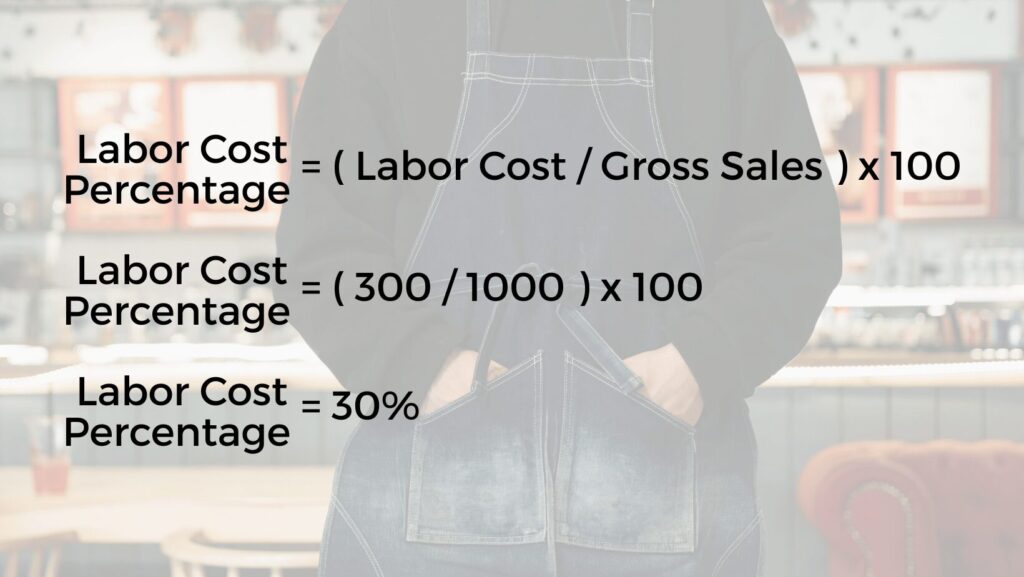
Labor Cost Percentage = Labor Cost / Gross Sales x 100
Labor Cost Percentage = 300 / 1000 x 100
Labor Cost Percentage = 30%
Pro Tip → Use round numbers for your labor cost percentage calculations instead of decimals. They’re easier to visualize and see progress on!
What is the Ideal Labor Cost Percentage?
For the restaurant industry in general, labor cost percentages average between 20-30%, but the target range differs slightly depending on the type of establishment you have.
For quick-service restaurants, the average labor cost percentage is usually 25-30%.
QSRs typically have a lower labor cost percentage than full-service restaurants because product preparation and service are typically faster, and menu items are typically cheaper.
For full-service restaurants, the average labor cost percentage is usually 30-35%.
That higher labor cost percentage is largely due to the complexity of back-of-house operations and menu items and the greater staff involvement that comes with table service.
How Do I Decrease My Labor Cost Percentage?
There’s no magic answer to decreasing your labor cost percentage, mostly because restaurants aren’t a one-size-fits-all industry. That said, there are a few high-level things you can do to make sure your labor cost percentage is the lowest it can be.
1. Tighten up your scheduling
Tightening up your scheduling practices is one way to decrease your labor cost percentage.
Now, this doesn’t necessarily mean cutting hours or reducing the number of people you have on staff, but rather figuring out where things aren’t as productive as they could be.
A good way to do this is by staggering your staff’s start times by 15-30 minutes. Have one person scheduled to set up, one person scheduled when the doors open, and another scheduled when the rush begins. That way, you’re not paying for all three staff members from the beginning of the day when you really only need one.
2. Increase your sales volume
If you can’t reduce your staffing costs to decrease your labor cost percentage, you can try boosting your sales instead.
There are tons of different strategies you can use to increase your restaurant’s sales volume. You can start a membership or loyalty program to encourage purchases. You can upsell or suggest add-ons with push notifications and other restaurant app features. You can even try implementing Starbucks’ psychology-based sales tactics, like the Decoy Effect or the IKEA Effect!
No matter which method you try to increase your restaurant’s profit margins, any boost in sales will do good things for your labor cost percentage!
3. Audit your menu pricing
Another way you can decrease your labor cost percentage is to audit your menu pricing, ensuring you’re earning the most you can from every item.
A good place to start for a menu audit is exploring your restaurant’s food costs. Check that the prices of your menu items accurately reflect the cost of ingredients that go into them, and spend smarter by reducing waste where you can.
From there, you’ll want to dive into some menu engineering. This can help you figure out which menu items aren’t generating the profit you need, and which ones are doing all of the heavy lifting (and might deserve more attention).
Craver’s FREE Labor Cost Percentage Calculator
Ready to start exploring your restaurant’s labor cost percentage? Make things easier (and skip the manual math!) with our free Labor Cost Percentage Calculator.
Enter the right numbers and get an instant labor cost calculation, so you know exactly where your labor costs stand and whether they need more attention.
FAQs
It depends! Reducing labor costs has a more immediate impact because you “get money back” from staffing costs right away. Increasing sales is a stronger long-term strategy, especially since it impacts more of your business than just labor cost percentages.
What’s the difference between labor cost percentage and prime cost?
Labor cost percentage is a specific measure of staffing expenses for a specific time period. Prime cost is a higher-level metric that involves your cost of goods sold and total labor costs, giving you insight into what core expenses you need to keep operating.